
Cooking Substitutes is a blog dedicated to exploring suitable alternatives in recipes, providing helpful how-to guides, and sharing mouthwatering recipes.
We're here to make your culinary adventures even more delightful!
Are Air Fryers Toxic? The Honest Answer
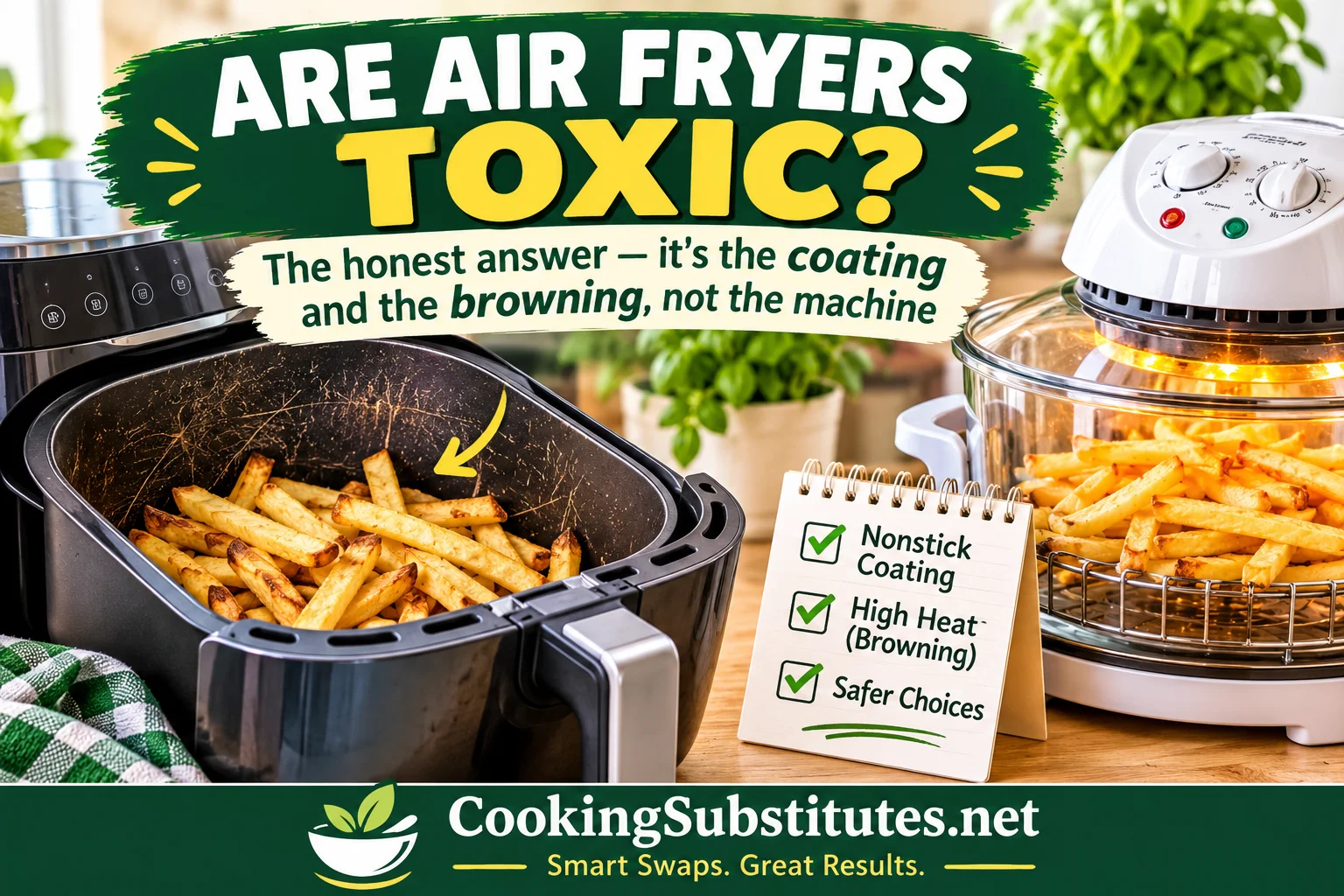
Are air fryers toxic? I get this question more than any other, usually late at night, usually from someone standing in their kitchen staring at their basket like it just betrayed them. I understand. One video says “forever chemicals,” the next says “cancer,” and suddenly the machine that made your perfect fries feels like a stranger.
So here is my honest answer, before any details: No — an air fryer is not toxic by itself. It is a small, strong convection oven. But two real concerns hide inside that simple answer, and both are worth understanding: (1) the nonstick coating on most baskets, and (2) a compound called acrylamide that forms in starchy food at high heat. Neither one means “throw it away today.” Both mean “use it smart, and choose better materials when you buy your next one.” That is what this whole guide is for.
As an Amazon Associate, I earn from qualifying purchases.
Quick Answer: The Whole Story on One Table
| Question | Honest answer |
|---|---|
| Is the air fryer machine itself toxic? | No. It is hot air, a fan, and a heating element — like a small oven. |
| What is the coating concern? | Most baskets use PTFE (the Teflon-type coating), a PFAS-family material. Intact and used normally, regulators allow it. Overheated or badly scratched, it becomes a real question. |
| At what heat does PTFE break down? | Around 500°F / 260°C. Most air frying happens at 350–400°F. |
| What is acrylamide? | A compound that forms in starchy foods (potatoes, bread) above about 248°F / 120°C when they brown deeply. |
| Does air frying cause cancer? | No study proves that. Acrylamide caused cancer in animals at very high doses; human food studies are not conclusive. |
| Is air frying safer than deep frying for fries? | In several studies, yes — air-fried potatoes made far less acrylamide than deep-fried ones (up to 90% less in one well-known study), and use far less oil. |
| The safest materials | Glass, stainless steel, and true ceramic-coated baskets with no PTFE/PFAS — see my 3 picks below. |
| The one rule that matters most | Never preheat an empty coated basket on max, and replace a basket once the coating flakes. |
Short on time? Keep your fryer, follow the 7 safe-use rules further down, and when it is time to replace it, buy glass, steel, or ceramic. Now the details — in plain words, I promise.
First, What an Air Fryer Actually Is
Strip away the marketing and an air fryer is three things: a heating element, a strong fan, and a small box. The fan pushes very hot air around your food very fast. That is it. There is no special “fryer chemical,” no radiation trick, nothing sprayed on your food.
That is why I always say: an air fryer cannot be toxic on its own — only its materials and your cooking habits can raise questions. So let us look at the two real ones, one by one, without panic.
Concern 1: The Nonstick Coating (PTFE, Teflon, and PFAS)
Most air fryer baskets are coated with PTFE — the material most of us know by the brand name Teflon. PTFE belongs to the big PFAS family, the “forever chemicals” you hear about in the news. That family link is exactly why people worry, so let us separate fact from fear:
What is calm and true:
- The FDA’s page on authorized PFAS uses in food contact explains that PTFE coatings are polymerized — locked into very large molecules, tightly bound to the pan — and that studies show only negligible amounts can migrate into food.
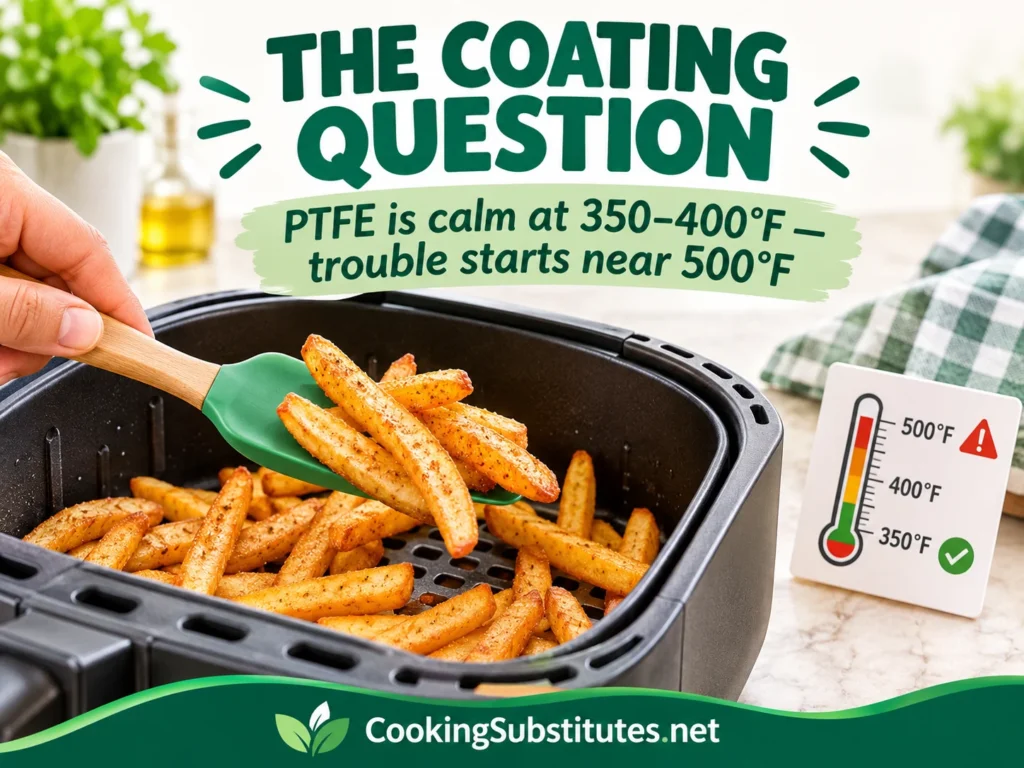
- PTFE is stable at normal cooking heat. It only starts to break down at around 500°F / 260°C. Most air frying is done at 350–400°F, and most home air fryers top out at 400–450°F.
- The old chemical behind the worst headlines, PFOA, was phased out of US manufacturing years ago (the phase-out completed around 2013). A modern basket is not made the 2005 way.
Where the real risk lives:
- Overheating an empty basket. With no food inside to absorb heat, a coated basket preheating on max can climb much closer to that 500°F danger line than the display suggests. This is the number one habit to drop.
- Fumes at breakdown heat. If PTFE does overheat badly, the fumes can cause polymer fume fever in people — a short, flu-like illness — and they are acutely toxic to pet birds, whose lungs are far more sensitive than ours. If you keep birds, this section is written for you: keep them well out of the kitchen while any coated pan or fryer runs, and ventilate.
- A scratched, flaking basket. Scratches do not poison your dinner — swallowed PTFE flakes pass through the body — but a 2022 study often cited in this debate estimated that one scratch on a coated pan can release around 9,100 plastic particles. Whether or not that number worries you, a flaking coating has finished its working life. That is not a coating anymore; that is confetti.
The label trap I want you to remember: “PFOA-free” does not mean “PFAS-free.” Almost every modern PTFE basket is honestly PFOA-free — and still PTFE, still PFAS-family. If you want out of the family entirely, look for brands that say “PFAS-free” in plain words, or choose glass, steel, or ceramic below.
Concern 2: Acrylamide — the One That Is About Food, Not the Machine
Acrylamide is not in your air fryer. It is created in your food — when starchy foods like potatoes and bread cook above about 248°F / 120°C and turn brown. Fries, roast potatoes, toast, chips: the darker and crispier, the more acrylamide. Your oven and your deep fryer do this too. It is a heat-and-starch story, not an air-fryer story.
What the science actually says, honestly:
- The IARC (the World Health Organization’s cancer agency) classifies acrylamide as a probable carcinogen — based on animal studies at doses far above what we eat. Large human studies on normal diets have not found consistent evidence that dietary acrylamide causes cancer. Concern: fair. Panic: not supported.
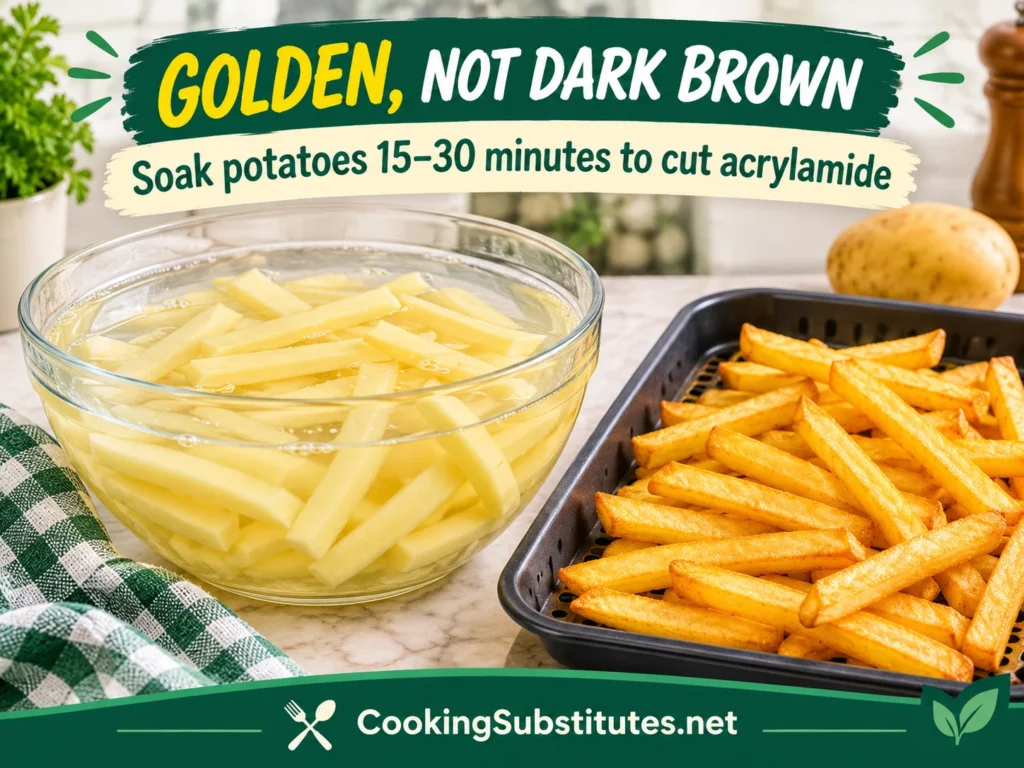
- Here is the part the scary videos skip: air frying is usually the lower-acrylamide way to make fries. A widely cited 2015 study in the Journal of Food Science found air-fried potatoes produced up to 90% less acrylamide than deep-fried potatoes. Results vary with temperature and time — burn anything dark brown and the numbers climb again — but swapping the deep fryer for the air fryer is a step down in exposure, not up.
- The FDA’s practical advice is simple and device-free: cook starchy food to golden yellow, not dark brown, and soak cut potatoes in water for 15–30 minutes before cooking to cut formation further. The California OEHHA acrylamide FAQ collects the same FDA tips in one plain page, if you want them straight from a public health source.
So no, air frying does not “cause cancer.” Over-browning starchy food — in any appliance — is the habit to fix.
The Safer-Materials Ladder: What to Buy Instead
If the coating question still sits in your stomach, you do not have to argue with it. Just climb one rung:
| Rung | Material | Why it is calmer | What to watch |
|---|---|---|---|
| 1 — Calmest | Glass bowl / glass containers | No coating exists at all; nothing to scratch or flake | Check the crisper plate material; glass needs gentle hands |
| 2 | Stainless steel basket / oven | Bare metal, scrubbable, lasts for years | Food sticks a little; check for one coated tray hiding in the box |
| 3 | Ceramic-coated basket (PFAS-free) | No PTFE; smooth, easy release | Ceramic coatings wear faster; buy from brands that state “PFAS-free” clearly |
| 4 | Modern PTFE basket, used correctly | Allowed by regulators; fine at normal temps with an intact coating | Never preheat empty on max; replace when it flakes |
I climb this ladder in full detail in two guides: Glass vs Stainless Steel Air Fryer compares rungs 1 and 2 side by side, and Stainless Steel vs Ceramic Air Fryer does the same for rungs 2 and 3. And if you want the short route, there are my three picks.
My 3 Safer Picks (the Ones I Point Family To)
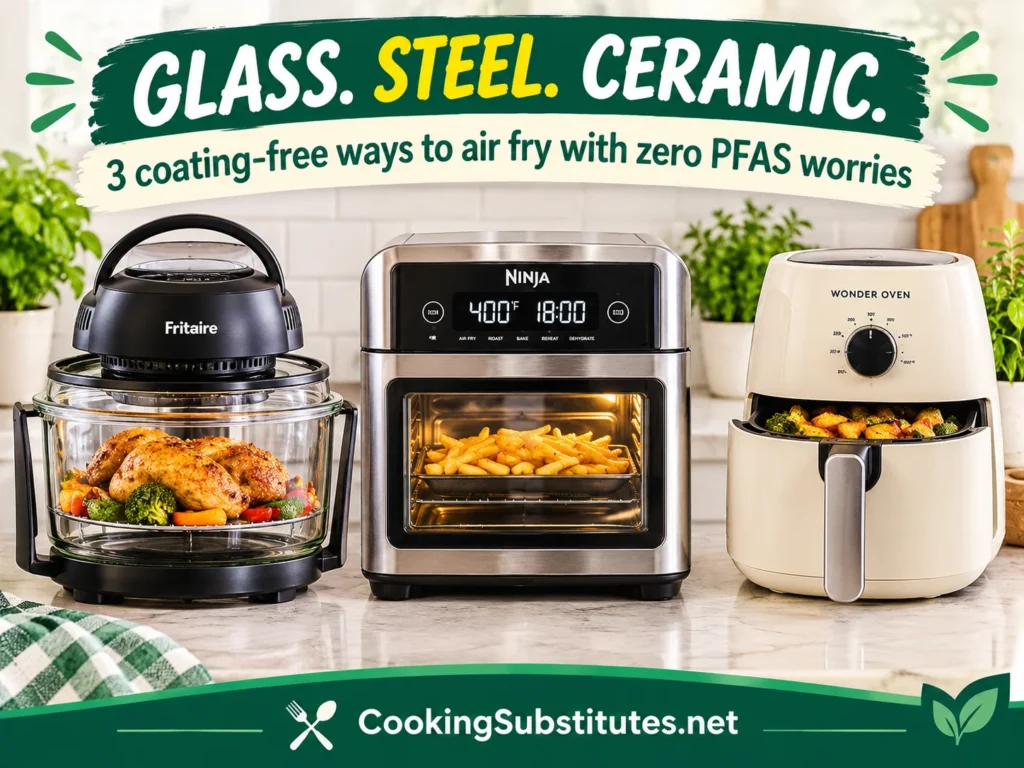
1. Fritaire 9-in-1 Glass Air Fryer — the Purest Materials on This Page
If your whole goal is “nothing coated touches my food,” start here. The Fritaire cooks in a 5-quart tempered glass bowl, and every accessory — rotisserie spit, tumbling fry basket, air stand — is 304 stainless steel. Fritaire states no PTFE, PFAS, or BPA on any food-contact surface. You watch everything cook from every side, and a self-cleaning cycle runs hot soapy water in the bowl when you are done. My honest notes: top heat is 400°F, so steel ovens crisp a touch faster, and the lid unit is heavy — lift it with respect.
| Spec | Detail |
|---|---|
| Capacity | 5 Qt glass bowl |
| Food-contact parts | Tempered glass bowl; 304 stainless steel rotisserie, tumbler, and stand |
| Temperature | Up to 400°F |
| Power | 1,300 W |
| Functions | 9 (Air Fry, Bake, Roast, Broil, Reheat, Dehydrate, Rotisserie, and more) |
| Special feature | Self-cleaning cycle; 360° view |
| Price | Around $180–$200 |
Pros:
- Glass bowl + steel accessories — no coating anywhere near the food
- Watch cooking from every angle
- Self-cleaning cycle does the greasy work
- Rotisserie and tumbling basket included
Cons:
- Max 400°F — a touch slower to crisp than 450°F ovens
- Heavy lid; bowl needs careful two-hand handling
- Short warranty
What buyers say: Owners love the clear view and the self-clean cycle most, and many bought it exactly to escape coatings. The common complaints are the heavy lid and slower crisping at big loads.
2. Ninja Crispi 4-in-1 (FN101) — Glass for Small Kitchens and Meal Prep
The Crispi is a clever little system: a PowerPod lid that sits on borosilicate glass containers — a 4-quart and a small 6-cup — and crisps right inside them. Dinner done? Snap on a lid and the same container goes in the fridge. The glass is free from PFAS, PTFE, and nonstick coatings, and the containers are dishwasher, freezer, and microwave safe. My honest note, because I always check the plate: Ninja does not clearly state what the crisper plate is made of. If “zero coating anywhere” is your strict rule, the Fritaire above is the stricter pick — or ask Ninja before you buy.
| Spec | Detail |
|---|---|
| Capacity | 4 Qt + 6-cup glass containers |
| Food-contact parts | Borosilicate glass containers (crisper plate material not clearly stated) |
| Temperature | Up to 450°F |
| Power | 1,500 W |
| Functions | 4 (Max Crisp, Air Fry, Bake, Recrisp) |
| Special feature | Containers double as storage with snap lids |
| Price | Around $150–$180 |
Pros:
- Borosilicate glass handles temperature swings better
- Cook and store in the same container — less washing
- Very fast, very crisp for its size
- Small footprint, easy to put away
Cons:
- Crisper plate material is not clearly stated
- Small batches — not a big-family fryer
- Fewer functions than oven-style models
What buyers say: Owners rate it about 4.6 stars and praise the speed and the cook-and-store idea most. The size is the usual complaint — great for 1–3 people, small for a crowd.
3. Our Place Wonder Oven — Stainless Steel, and the Friendliest Oven-Style Pick
On the steel side, this is the friendly one. The Wonder Oven has a stainless steel interior with no PFAS, two rack levels in a compact 13-quart body, and a trick nobody else here has: steam infusion, a little shot of water that keeps chicken juicy and brings day-old pizza back to life. It preheats in about 2–3 minutes and fits a 4.5 lb chicken. My honest note, same as always: the air fry basket and rack are chrome-plated steel, and the baking pan in the box is ceramic-coated. I air fry on the basket and rack, and treat the pan as a bonus, not the main stage. A detailed outside roundup of non-toxic models, Kitchenware Sets’ “Are Air Fryers Toxic?” guide, reaches a similar shortlist if you want a second opinion before spending.
| Spec | Detail |
|---|---|
| Capacity | 13 Qt (12 L), 2 rack levels, fits a 4.5 lb chicken |
| Food-contact parts | Stainless steel interior; chrome-plated steel basket and rack; ceramic-coated bake pan |
| Temperature | Up to 450°F |
| Functions | 6 (Air Fry, Bake, Roast, Toast, Broil, Reheat) + steam infusion |
| Special feature | Steam infusion for juicy food and revived leftovers |
| Price | Around $185 |
Pros:
- Real stainless steel interior — no coating on the walls
- Steam feature is genuinely useful, not a gimmick
- Fast preheat; compact for an oven-style model
- Pretty enough to live on the counter
Cons:
- Bake pan is ceramic-coated (cook on the basket/rack for a coating-free setup)
- Too small for big families
- Premium price for its size
What buyers say: Owners praise the fast preheat, the steam trick, and the all-steel interior most — many bought it to replace a coated drawer fryer. Size is the common complaint.
Still torn between two of these? My free Air Fryer Finder asks your budget, your family size, and which material you trust — then points you to the right guide in under a minute.
Amina’s Hacks: 7 Rules to Use ANY Air Fryer Safely
You do not need a new machine to cook more safely tonight. You need these habits:
- Never preheat an empty coated basket on max. If a recipe says preheat, keep it short and at cooking temperature — or put the food in from cold and add a minute. Food in the basket is a heat shield.
- No metal utensils, no steel wool on coatings. Silicone or wood only, soft sponge only. Every scratch is a small door you cannot close.
- Replace the basket when the coating flakes or peels. Not next year. Now. A replacement basket costs far less than a new fryer — and far less worry.
- Ventilate above 400°F. Range hood on, or a window cracked. Good habit for all high-heat cooking, not just fryers.
- Keep pet birds out of the kitchen while it runs. Their lungs are built differently from ours. Door closed, every time, no exceptions in my house rules.
- Soak cut potatoes 15–30 minutes, pat dry, cook to golden — not dark brown. This is the acrylamide trio: soak, dry, golden. Your fries will still be fries, I promise.
- Do not store potatoes in the fridge. Cold storage raises the sugars that form acrylamide. Cool, dark cupboard is the right home for them.
So, Should You Throw Yours Away?
Almost certainly not. Read your situation honestly:
- Your coating is intact and you cook at normal temps → Keep it. Add the 7 rules. Sleep well.
- Your coating is scratched in a few spots → Keep cooking gently for now, stop using metal tools, and start watching for flakes.
- Your coating is flaking or peeling → Stop using that basket. Replace the basket, or replace the fryer with a glass, steel, or ceramic pick from above.
- You keep pet birds → Move to glass or steel, and keep birds out of the kitchen while anything hot and coated runs in the meantime.
- You are buying new anyway → Skip PTFE entirely. “PFAS-free,” glass, steel, or ceramic — the ladder is above, the picks are tested, and you will never think about this question again.
Questions People Ask Me
Is Teflon in air fryers safe?
At normal cooking temperatures, yes, according to regulators. The FDA authorizes PTFE coatings for food contact because the polymer is tightly bound and almost nothing migrates into food. The risk appears when PTFE is badly overheated (around 500°F / 260°C and above) or the coating is worn out. Use it below max-empty preheats, replace it when it flakes, and it stays in the “safe when used as directed” box.
Does air frying cause cancer?
No evidence says that. The cancer question is really about acrylamide, a compound that forms in browned starchy food in any hot appliance. It caused cancer in animals at very high doses; large human studies on normal diets have not found a consistent link. Air frying usually produces less acrylamide than deep frying, and soaking potatoes and cooking to golden (not dark brown) lowers it further.
What temperature makes PTFE dangerous?
PTFE starts to break down at around 500°F (260°C), releasing fumes that can cause a short flu-like illness (polymer fume fever) in people and are acutely toxic to pet birds. Most air fryers cook at 350–400°F and top out at 400–450°F, so normal cooking stays below the line — the danger is an empty basket preheating on max with nothing inside to absorb the heat.
Is ceramic better than Teflon in an air fryer?
For avoiding PFAS, yes: a true ceramic coating contains no PTFE, so there is no fume question at any home cooking temperature and nothing PFAS-family to scratch. The trade-off is durability — ceramic coatings usually wear out faster than PTFE, often in 1–3 years of heavy use. Glass and stainless steel beat both for long life, which is why they sit at the top of my ladder.
Should I throw away a scratched air fryer basket?
A light scratch: not yet — cook gently, use soft tools, and watch it. Flaking, peeling, or bubbling coating: yes, stop using that basket. Swallowed PTFE flakes are considered inert and pass through, but a flaking basket has ended its useful life. Replace just the basket if your brand sells one; if not, treat it as your sign to move to glass, steel, or ceramic.
Are air fryers BPA-free?
Mostly, the question does not apply: baskets and bodies are metal, coating, and heat-rated plastics, and BPA is not a normal air fryer ingredient. The parts worth checking are plastic accessories and storage lids. The Fritaire above states no BPA on food-contact surfaces; for other brands, if the listing does not say, ask the maker — honest brands answer this one fast.
Final Thoughts
Here is the sentence I would want, if I were you, standing in that kitchen at midnight: an air fryer is a small oven, not a chemical plant — respect the coating, respect the browning, and it will feed you safely for years. And when friends ask you, “are air fryers toxic?” you now have the calm, complete answer: not by themselves — it is the worn-out basket and the burnt-black fries that deserve your attention, and both of those are in your hands, not the machine’s.
Pin this post so the 7 rules are one tap away the next time a scary video finds you. 📌
— Amina 🍳
P.S. Tell me in the comments — did this calm you down, or are you switching to glass or steel anyway? I read every reply.
Affiliate Disclosure: CookingSubstitutes.net is a participant in the Amazon Services LLC Associates Program, an affiliate advertising program designed to provide a means for sites to earn advertising fees by linking to Amazon.com. When you buy through a link on this page, I may earn a small commission at no extra cost to you. Thank you for supporting the kitchen!